




In the cosy kitchen of the De Barra home in Cratloe, sipping a cup of tea that Noreen kindly offered me, I spoke to Domhnall about the Athea Parish Newsletter, its beginnings, the people who learned new skills through it, and why it is now coming to an end.
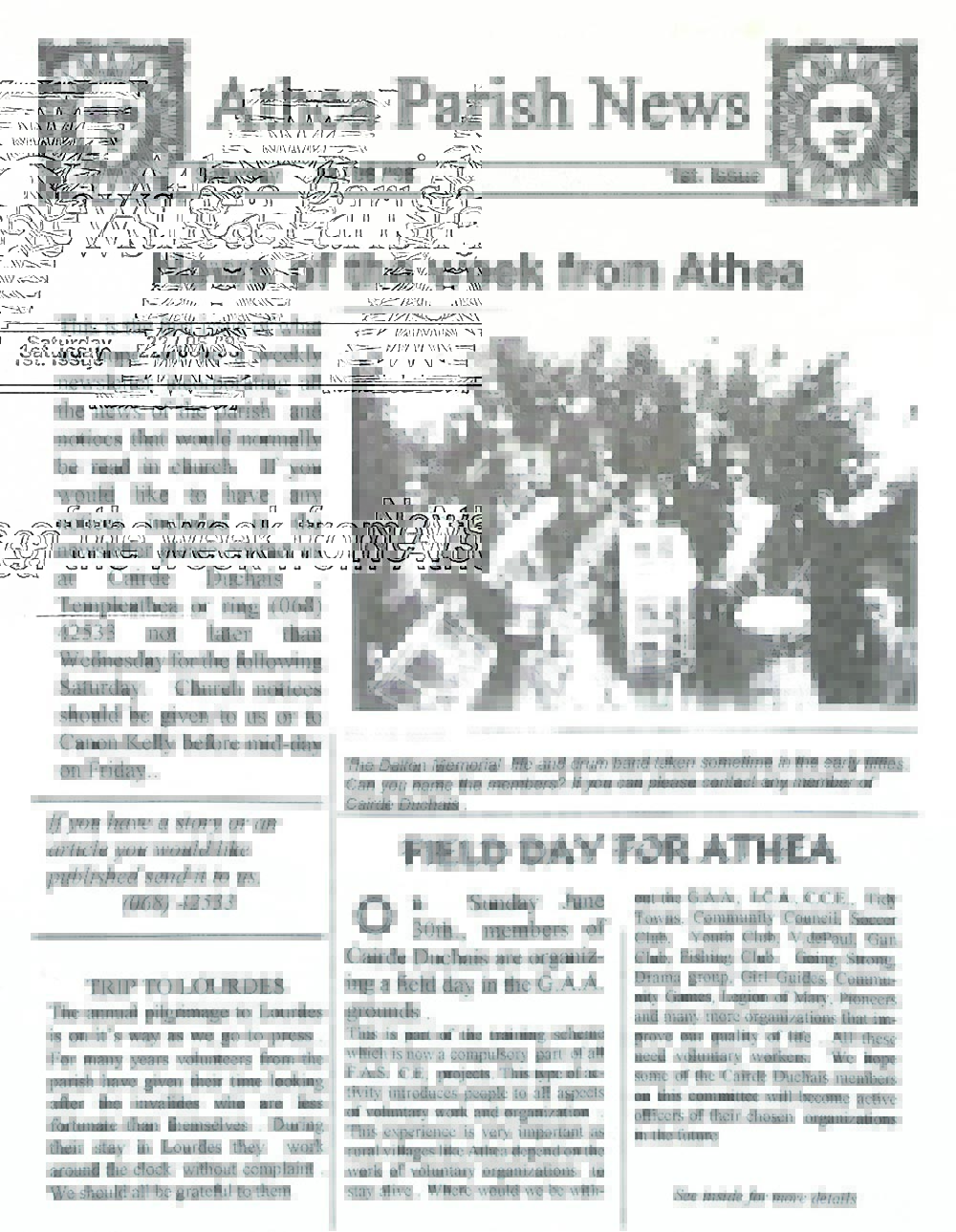
When Domhnall de Barra published the first edition of his community newsletter in June 1996, he was building on work that had begun years earlier. What started as part of a FÁS training scheme grew into a long-running local publication, a small printing business and, for many readers, a valued weekly link with community life.
In the late 1980s, de Barra formed Cairde Dúchais. It became a local publishing and community heritage group based in the village.
The group was most widely known for producing and compiling local publications, community newsletters, and historical updates for Athea and its surrounding districts. It worked closely with local initiatives like the Athea Tidy Towns and managed the distribution of community content. Domhnall explained “Traditional music, singing and dancing were already well served by Comhaltas”, he explained, but he believed other aspects of local heritage also deserved attention. The new group concentrated on folklore, drama and the wider traditional arts.
At the time, de Barra was working as an overseer on a FÁS scheme with the Community Council. Among other things, that Fás scheme created a record of all the local cemeteries. Pat Cotter, who was responsible for the scheme, encouraged Domhnall to develop a project for Cairde Dúchais. He agreed. Many of those who joined were women whose children had started school and who now had time to take part.
Education and practical training were central to the scheme. Participants formed a choir, played music, staged drama and brought a play to local venues. People who might never have imagined themselves as performers discovered new abilities, and the project was recognised as an incredible success.
The scheme also introduced people to computers and printing. At that time, computers were still new to many people, and even Domhnall himself had to learn the equipment before he could pass those skills on to others.
The first printer cost £450—considerable amount of money at the time. Scripts arrived in longhand, so the team had to type the entire newsletter. Domhnall knew nothing about publishing or typesetting when he began. “I had to start from square one and figure it all out,” he recalled.
He directed the work and made the final production decisions: what would fit, where each item should go and how the finished publication should look. “So, essentially, you acted as production manager” I asked. But Domhnall preferred another description: “I was kind of the finisher.”
When the FÁS scheme ended, it left a gap. He bought new equipment and established a private business, CD Printing. Lillianne O’Carroll, who had been involved in the scheme, joined him, and together they continued producing the newsletter.
The publication began as a four-page newsletter and eventually grew to 12 pages. In its early years, about 500 to 600 copies were printed weekly. The newsletter was sold after weekend Masses and through several local outlets. The crossword became one of its best-known and best-loved features.
The printing business was busy too. It produced hundreds of invoice books and business cards, as well as flyers and posters for weekend events. Over time, however, technology changed the market. Businesses began emailing invoices and printing only what they needed, while social media replaced much of the demand for posters and flyers.
The newsletter’s circulation declined most noticeably over the past four or five years. Lillianne stepped away around three years ago, leaving Domhnall to produce it largely on his own. The work had reached the point where continuing to publish was costing him money. It was no longer viable to keep it printed.
There was also a practical difficulty: Microsoft Publisher, the software he had used, was being discontinued. Moving to a new system would require learning another set of skills. Domhnall said he would consider allowing someone else to take over the newsletter, but he couldn’t continue under the present circumstances.
For a publication that began as a training exercise and became part of local weekly life, its closure marks the end of an era. Readers, de Barra believes, will miss it—and especially its crossword.
For older members of the community who are not online or do not use social media, a printed newsletter can be especially important. It offers an accessible and familiar way to keep up with local events, notices and stories, while helping readers remain connected to the life of their community. “There are still people who depend on the printed paper to know what is happening locally,” de Barra said. “Not everyone is online, and the newsletter has been an important link with the community.” Its loss therefore represents more than the closure of a publication: it removes a trusted source of information for people who may not be reached through digital channel.
Asked what he planned to do now, he admitted that he didn’t yet know. “I have to be very honest and say I don’t know. I have a few things that I probably want to do and I might consider that, but I won’t be idle!” He has a few ideas and may finally find time for a long-discussed project: writing a book. There is, without a doubt, a book in Domhnall de Barra.
He has a lifetime of stories and memories that can’t be lost. Domhnall served as President of Comhaltas for a total of six years, his first term from 1979 to 1982
And a second term from 1988 to 1989. In August 2024, his life’s dedication to music as a musician and teacher earned him the prestigious Ard Ollamh award at Fleadh Cheoil na hÉireann, the highest honour bestowed by Comhaltas Ceoltóirí Éireann. The story of his life would be a fascinating read, no doubt. He agreed that he has been fortunate to enjoy a varied life and varied careers, while witnessing some of the greatest changes of modern times.
Life presents constant change for all of us. How we deal with it shapes our future. In many ways, that exact philosophy mirrors the traditional Irish music community and local community that Domhnall dedicated his life to. For generations, musicians had to adapt to massive changes—emigration, modernization, and shifting cultural landscapes—yet they found ways to carry their heritage forward, reshaping it to fit new eras while keeping its core soul alive. When it comes to community changes, Domhnall has long served as a passionate observer and a vital anchor for his local area of Athea and no doubt, the story doesn’t end here.
The newsletter may be ending, but it will be interesting to see what Domhnall will do next!
The End of an Era for a Community Newsletter
October 1, 2026
Featured Stories, Home Slider, Weekly Observer