




On Saturday, November 8th, 2025, I officially became a member of the “used to work at Murray’s” club! After over fifty-two years, the time had come to hang up the footwear gauge and the shoe horn and to push the fitting stool aside. I left behind fifty two years of many happy memories – and a few sad ones. This coincided with a significant birthday. The spirit was still willing but, unfortunately, the body was not! Wouldn’t it be great if we could sync our physical age with our mental age? My decision was assisted and confirmed by recent events.
Primary school education was at Killacolla National School in my native Rockhill-Bruree followed by secondary school at C.B.S. in Charleville, first in the old school at Main Street and then at the new school on Baker’s Road. I started work at Murray’s and Son, Ltd., Main Street, Charleville, at the end of September, 1973. Timing is everything – a random visit to the shop to enquire if there was any job available resulted in an interview and a job offer. My post Leaving Certi-ficate intentions had not gone according to plan and this was to be a short term job until those got back on track. They never did and, in the blink of an eye, fifty two years later I’m retiring from that first job! Apart from a few weeks working at John R’s Bar (Ducketts) at Christmas 1973 and during the 1974 Cheese Festival, this was my only job.
When I started working, the five day week was the norm. Thursday was the closed day in the town. A town-wide strike in the drapery, footwear, hardware, grocery, provisions and distributive trades in the town in the run up to Christmas, 1970, had brought this about. Prior to that work was typically six days with late opening until 9pm on Saturday night. The strike also secured across the board wage increases and a sick pay scheme. Within a couple of years of starting work, I became branch secretary of the Charleville branch of the Irish Union of Distributive Workers and Clerks, now Mandate.
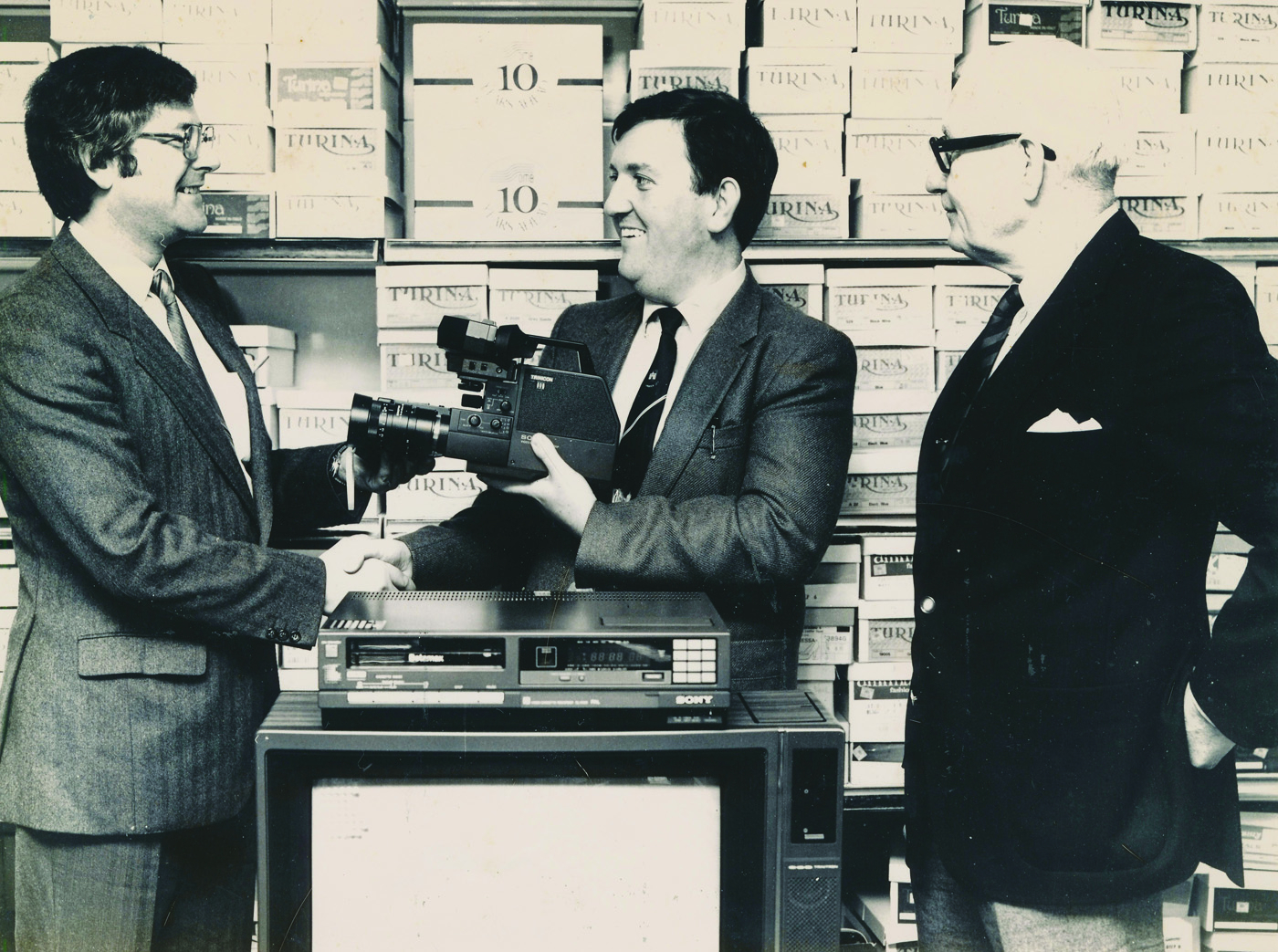
Working in the shoe department was a challenge at first, particularly as the vast majority of the stock was in boxes with very little on display. Getting to know which style was in which box took a while and memory had to be refreshed regularly as new stock arrived. Gradually, the accepted layout of shoe shops changed with displays replacing rows and rows of boxes. Murray’s shoe department became all display in 1989. But then you had to remember where the second half of the pair of shoes on display at the front of the shop was stored in the stockroom at the back. And there could be between 200 and 300 individual shoes on display and up to ten times that number in the stockroom! The shoe department received it’s most recent facelift during the 2020 Covid-19 lockdowns.
Children’s shoes were always, and still are, a huge part of the Murray footwear business. Clarks and Murray’s became synonymous when the first order from the Dundalk based manufacturer was delivered to Main Street, Charleville, over 75 years ago. The big selling point for the brand became the fact that shops who stocked their shoes offered a full fitting service. I was trained by Clarks in the basics of shoe fitting and how to ensure that every young customer went home with the best possible fitting shoes. Later on, an advanced training course covered foot health and foot problems and how to deal with them. Clarks were very innovative both style wise and marketing wise being one of the first brands in the late 1980s to introduce children’s shoes with lights. These, of course, were a big hit with the children if not with their parents. They had children’s shoes with toys hidden in the heels, shoes with a magic key, shoes with characters, shoes with dinosaurs as well as collaborations with the likes of Disney. First shoes were most parents and toddlers first introduction to Murray’s shoe depart-ment. We took pride in making our new young customers feel at home and at ease as we fitted their first shoes. At one stage, parents were provided with a souvenir photo, taken with a Polaroid camera provided by Clarks, of the young prince or princess in the first shoes, in a special card folder. Smart phones superseded this in recent years.
It was a low point of my retailing career a few years ago when, because of declining sales, Murray’s and Clarks had to part company after such a long association. The increasing popularity of branded trainers for children had decimated the traditional children’s shoe trade.
It gave me great pride when parents brought in their children (or even grandchildren!) for their first shoes and reminded me that I had fitted them with their first shoes many years before and even recalled styles of shoes I had fitted on them. I must have been doing something right down all those years!
Over the past fifty-odd years, I saw many changes in the footwear world. When I started selling shoes at Murray’s, a great proportion of the stock we carried was made in Ireland. There were factories up and down the country making shoes for men, women and children. We had suppliers in Edenderry, Emyvale, Dundalk, Drogheda, Kilkenny, Ballinasloe, Killarney, Cork and Dublin. They manufactured ladies fashion shoes and boots, work boots, football boots, children’s shoes and boots and even wellingtons. All these are now gone as indigenous manufacturers and all that are left are a few small, specialist manufacturers. The demise of the Irish footwear manufacturing industry had another repercussion on Murray’s sales. In the “good old days”, I would regularly make trips to Ballinasloe or Kilkenny to pick up a car load of manufacturing seconds – shoes which had been slightly damaged during the manufacturing process. This might be a scratch, a discolouration, a crooked line of stitching, none of which affected the durability of the shoe but resulted in a substantial discount to be passed on to Murray’s customers. At one stage in the early 1980s, we bought 300 pairs of ladies hand stitched leather moccasins, all samples and all size 4. They were available in flat, mid and high heels and were normally priced at £20.00 plus. We were able to sell them at £7.99 a pair or two pairs for £15. Feet were a lot smaller back then and they were snapped up in double quick time!
Murray’s were noted for their ability to source special offers not just in footwear but for all departments but for many years there were regular special offers in the shoe department. During the 1970s, Murray’s became associated in many people’s minds with sheepskin boots for men and women. We had built a relationship with two companies (one is still trading) in the south west of England who specialised in making boots and slippers lined with sheepskin as well as sheepskin gloves. Again, we provided a convenient outlet for the disposal of their seconds and every winter we would take delivery of hundreds of pairs. In the early 1970s men’s sheepskin boots retailed at a reduced price of £4.25 – about half their normal price. As time went on, heating systems in homes, cars and elsewhere became more efficient and the demand for warm boots declined through the 1980s. However, I’m sure that, at the bottom of wardrobes around Munster, there are still pairs of these boots hiding, particularly men’s. They seemed to last forever!
Over fifty years, the fashions in footwear have changed drastically. Who remembers platform shoes and boots for men and women (invariably worn with very wide bell-bottom pants), women’s white patent knee boots, doc martens, monkey boots, desert boots, loafers and penny loafers, jellies, crepes, galoshes? Some are still there, some are long gone but who is to say that fashion won’t complete the circle and that long dead styles might once again hit the high street? Pop stars and groups as well as celebrities had and still have a big influence on fashion. The Bay City Rollers wore colourful platform boots (and tartan!), bands like Madness wore Dr. Martens while bands like Showaddywaddy wore crepes (they even had an album called Crepes and Drapes). And, of course, Princess Diana worked wonders for ladies flat pumps!
Trainers also became big in the 1970s and 1980s and the big brands found new customers away from the world of sports and athletics. Most of the big name sports brands are now available mainly through sports shops and departments. However, it is interesting that styles of trainers which I sold in big quantities forty years ago are now back in fashion with a new generation. I wonder do they know that the styles they are wearing as the latest fashion are actually over forty years old?
Fifty years ago, men aspired to having an all leather shoe in their wardrobe “for good wear”. Because good quality, welted, leather soled men’s shoes require a lot of hand work, their prices have climbed rapidly and they are now so expensive that they are very much a niche market. When I started selling men’s shoes, brogues and toe capped shoes in either oxford or gibson styles were always in stock. Even at that stage these were expensive but they had the advantage that they could be half-soled/re-soled numerous times – and there were cobblers there to do the work. I remember when a man would buy a pair of leather soled shoes, we would tell him to go to the hardware shop and buy a pair of Phillips stick on soles and put them on the shoes before he wore them. This meant that the original sole was not wearing and the stick on sole stopped the leather absorbing moisture. Modern soling materials have replaced both leather and rubber soles on both ladies and men’s shoes. These materials are more durable, more comfortable to wear and can be made in practically any shape or design. More importantly, they can be manufactured and added to the upper by machinery rather than by hand.
Often, my job strayed outside the bounds of the shoe department. In the 1970s, Murray’s started a manufacturing unit at the back of the Main Street shop. The unit had originally operated in Buttevant, run by the Sisters of Mercy, with Murray’s buying all their production. When the building was needed as classrooms, it was decided that Murray’s would continue manufacturing, transferring the production unit, and most of it’s employees, to Charleville. The sewing factory, as it was known, made workwear and church vestments. The workwear was supplied to county councils throughout the country as well as to semi-state bodies and various factories both local and further afield. The church vestments were supplied directly to clergy throughout Ireland as well as being exported to the UK and Europe. I became involved to the despatch process via couriers as well as delivering consignments personally. Delivery of the raw materials – i.e. rolls of fabric – was to the front of the shop. These rolls – often hundreds of rolls containing 200/250 metres of cotton or polyester/cotton – would have to be manually taken from the street to the cutting room. It was all hands on deck for this job – a job nobody particularly wanted! Huge bales of cheesecloth were also delivered to the Main Street and these would also have to be manhandled to the stock room. A two wheeled, flat hand truck made the job a little easier – one person in front at the handles pulling and the second at the back pushing. It would have made great training for the Charleville rugby team! Of course, as everyone now knows, I had an ulterior motive for helping out at the sewing factory – it was there I first met Kathleen – the love of my life. It was my luck that she had decided to transfer to Charleville when Murray’s took over the sewing factory! So I have many things for which to be grateful to Murray’s.
Being part of Murray’s “family” made for a very happy work life. I have had the privilege of working with four generations of the Murray family, all very different personalities but all very honourable. It was a family and a business with a great history and I always took a great interest in that history – an interest which was reciprocated by many customers who came into the shop. I was lucky to have had a family of fellow workers from the very beginning who were helpful and supportive, all of whom I could genuinely call friends. Unfortunately, many are no longer with us, but many of those who no longer work in the shop keep in touch and, when the opportunity arises, drop in to recall the many memories – happy, funny, sad, maybe some we’d rather forget! Very many customers also became friends and it was a pleasure to look after their needs. Regular customers, many from several generations of the same family, relied on Murray’s staff for advice and for honest opinions. There was often a great feeling of trust between customer and staff member and we respected that trust. Many people in the shoe trade also become good friends. These were people who, in the early days, called to the shop on a regular basis to sell their wares and contacts in company offices and warehouses. Later, it became the norm to meet sales representatives in hotels to see the upcoming styles and ranges. It was important to build these relationships – often a phone call would come with news of some special offers!
Will I miss the job? Yes! Will I miss the work? No! I’ll miss meeting people, particularly the children. I’ll miss meeting my fellow workers and the good times we’ve had. I think I will miss the daily and weekly routine as well – or maybe not! But the time has come to call it a day. My last day at Murray’s was emotional, to say the least. A few years back, Will Shakespeare said “Parting is such sweet sorrow”. It was with mixed emotions I said goodbye to a place which has been a second home to me for most of my life, said goodbye, or rather au revoir, to my co-workers, to the Murray family and my many regular customers and friends. Thanks to all those who called in to say thanks and to offer their good wishes. Thanks to everyone who made my life at Murray’s so enjoyable for the past fifty-two years.